

'%3e%3cpath%20d='M24%200C10.7453%200%200%2010.7453%200%2024C0%2035.255%207.74912%2044.6995%2018.2026%2047.2934V31.3344H13.2538V24H18.2026V20.8397C18.2026%2012.671%2021.8995%208.8848%2029.9194%208.8848C31.44%208.8848%2034.0637%209.18336%2035.137%209.48096V16.129C34.5706%2016.0694%2033.5866%2016.0397%2032.3645%2016.0397C28.4294%2016.0397%2026.9088%2017.5306%2026.9088%2021.4061V24H34.7482L33.4013%2031.3344H26.9088V47.8243C38.7926%2046.3891%2048.001%2036.2707%2048.001%2024C48%2010.7453%2037.2547%200%2024%200Z'%20fill='black'/%3e%3c/g%3e%3cdefs%3e%3cclipPath%20id='clip0_1062_940'%3e%3crect%20width='48'%20height='48'%20fill='white'/%3e%3c/clipPath%3e%3c/defs%3e%3c/svg%3e)
'%3e%3cpath%20d='M44.4469%200H3.54375C1.58437%200%200%201.54688%200%203.45938V44.5312C0%2046.4437%201.58437%2048%203.54375%2048H44.4469C46.4062%2048%2048%2046.4438%2048%2044.5406V3.45938C48%201.54688%2046.4062%200%2044.4469%200ZM14.2406%2040.9031H7.11563V17.9906H14.2406V40.9031ZM10.6781%2014.8688C8.39062%2014.8688%206.54375%2013.0219%206.54375%2010.7437C6.54375%208.46562%208.39062%206.61875%2010.6781%206.61875C12.9563%206.61875%2014.8031%208.46562%2014.8031%2010.7437C14.8031%2013.0125%2012.9563%2014.8688%2010.6781%2014.8688ZM40.9031%2040.9031H33.7875V29.7656C33.7875%2027.1125%2033.7406%2023.6906%2030.0844%2023.6906C26.3812%2023.6906%2025.8187%2026.5875%2025.8187%2029.5781V40.9031H18.7125V17.9906H25.5375V21.1219H25.6312C26.5781%2019.3219%2028.9031%2017.4188%2032.3625%2017.4188C39.5719%2017.4188%2040.9031%2022.1625%2040.9031%2028.3313V40.9031Z'%20fill='black'/%3e%3c/g%3e%3cdefs%3e%3cclipPath%20id='clip0_1062_932'%3e%3crect%20width='48'%20height='48'%20fill='white'/%3e%3c/clipPath%3e%3c/defs%3e%3c/svg%3e)
EV Jargon Decoded: Abbreviations in the EV World
From SoC to NACS — a quick reference to the terms you will see in ABRP and across the EV world.

Johannes Aguilar Kazantzidis
Senior Software Engineer
“MSc from Imperial College London, former engineer at Stanford University, background in nuclear accelerators, now applying that same rigour to EV route planning.”
Electric vehicles and route planning bring a lot of shorthand: SoC, kWh, CCS, OBD, and more. Whether you are comparing cars in ABRP, reading charging labels, or setting up live data, a few key abbreviations keep coming up. This guide explains the ones that matter for driving, charging, and understanding your EV.
A reference to EV-related abbreviations: product and app names, vehicle and drivetrain, charging and energy, and live data and connectivity.
Product and app
| ABRP | A Better Routeplanner. The route-planning app and service that calculates when and where to charge based on your EV, conditions, and destination. |
| EV | Electric Vehicle. Any vehicle powered fully or partly by a battery and electric motor (often used for battery-electric only). |
| OEM | Original Equipment Manufacturer. In the EV world this usually means the carmaker (e.g. Tesla, Rivian, Hyundai) that builds the vehicle and often provides built-in apps or connectivity. |
Energy and range
| SoC | State of Charge. The battery level, usually shown as a percentage (e.g. 80% SoC). ABRP uses SoC to plan when you need to charge and how long to stay at each stop. |
| WLTP | Worldwide Harmonised Light Vehicles Test Procedure. A standardised lab test used mainly in Europe to produce official range and efficiency figures. Real-world range is often lower depending on speed, temperature, and driving style. |
| EPA | In an EV context, the US Environmental Protection Agency range and efficiency ratings for vehicles sold in the United States. EPA numbers are another reference point; real-world results vary. |
Charging
| CCS | Combined Charging System. A DC (and AC) connector standard common in Europe (CCS2) and North America (CCS1). Most non-Tesla EVs and many public chargers use CCS. |
| CHAdeMO | A DC fast-charging connector standard developed in Japan. Common on older Japanese EVs and some chargers; less common on new models in Europe and North America. |
| NACS | North American Charging Standard. Originally Tesla's connector, now an open standard (SAE J3400). Many new EVs in North America will use NACS, and adapters allow CCS cars to use NACS chargers. |
For a detailed overview of connector types and where they are used, read our article on the topic.
Bidirectional charging
Some EVs can send energy back out of the battery, not just take it in. These terms describe how and where that power can go:
| V2X | Vehicle-to-Everything. An umbrella term for any scenario where the EV sends stored energy back out to a home, the grid, a load, or another device. |
| V2H | Vehicle-to-Home. The EV feeds power to a home's electrical system, acting as a backup battery during outages or to offset peak-rate electricity. |
| V2G | Vehicle-to-Grid. The EV exports energy back to the electricity grid, potentially earning credits or revenue for the owner while helping balance grid demand. |
| V2L | Vehicle-to-Load. The EV powers external devices directly, appliances, tools, or camping gear, through an onboard outlet or adapter, without needing a home electrical panel. |
| V2B | Vehicle-to-Building. Similar to V2H but on a larger scale: the EV supplies power to a commercial or multi-unit building. |
Live data and connectivity
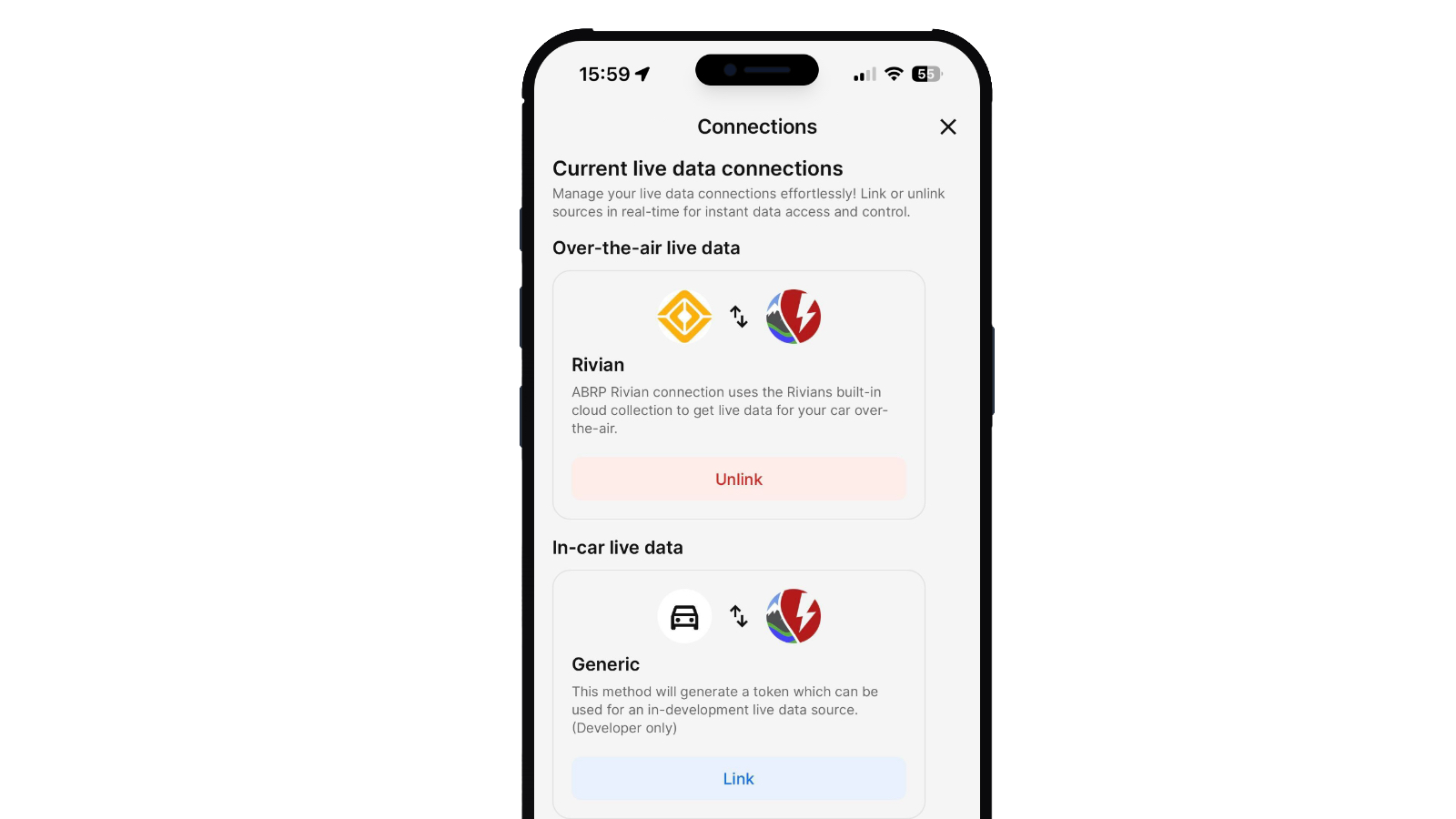
ABRP can use live data from your car to show real-time SoC, position, and charging state. These terms often appear when you set that up:
| OBD | On-Board Diagnostics. The standardised port (usually under the dashboard) that diagnostics and dongles use to read data from the car. Some ABRP live-data solutions use an OBD dongle to get SoC and other signals. |
| OEM | OEM app or OEM integration: When the carmaker's own app or in-car system sends data to ABRP (e.g. via an account link). No dongle needed; availability depends on the brand and model. |
| OTA | Over-The-Air. Software or firmware updates delivered wirelessly to the car or to a device. Many EVs receive OTA updates for features and battery behaviour. |
| BLE | Bluetooth Low Energy. A wireless technology used by some OBD or accessory devices to send live data to your phone and then to ABRP. |
| Enode | A platform that connects EVs to apps over the air using the manufacturer's own connected services. ABRP uses Enode to provide live data (SoC, location, charging state) for a wide range of vehicles without needing a dongle. Available as part of ABRP Premium. |
| TRONITY | A third-party service that connects your car to apps (including ABRP) in supported regions. It is one of several ways to get live data without a dongle, depending on your vehicle and country. |
When a live-data method is region-restricted, it may only work in certain countries or areas; ABRP will indicate that where relevant.